Home Recipes
Stuff I make at home. Memories from my childhood.
Bread with the Egg in the Middle
This is the first special meal that I can remember my mother making for me. She called it Bread with the Egg in the Middle. Later, as an adult, I found out that it was not invented by my mother and that it was also knows as Egg in a Basket or Egg in a Hole or Bird in a Nest or Uova Fritte nel Pane (Fried Eggs in Bread). It’s one of the first things I learned to cook when I moved out of my parents’ house. When I made this for breakfast in one of the early apartments or in any of the subsequent houses that I lived in, I could immediately flash back (like a video playback) to me sitting at the table in my parents’ eat-in kitchen and my mother putting down a plate of Bread with the Egg in the Middle for me.
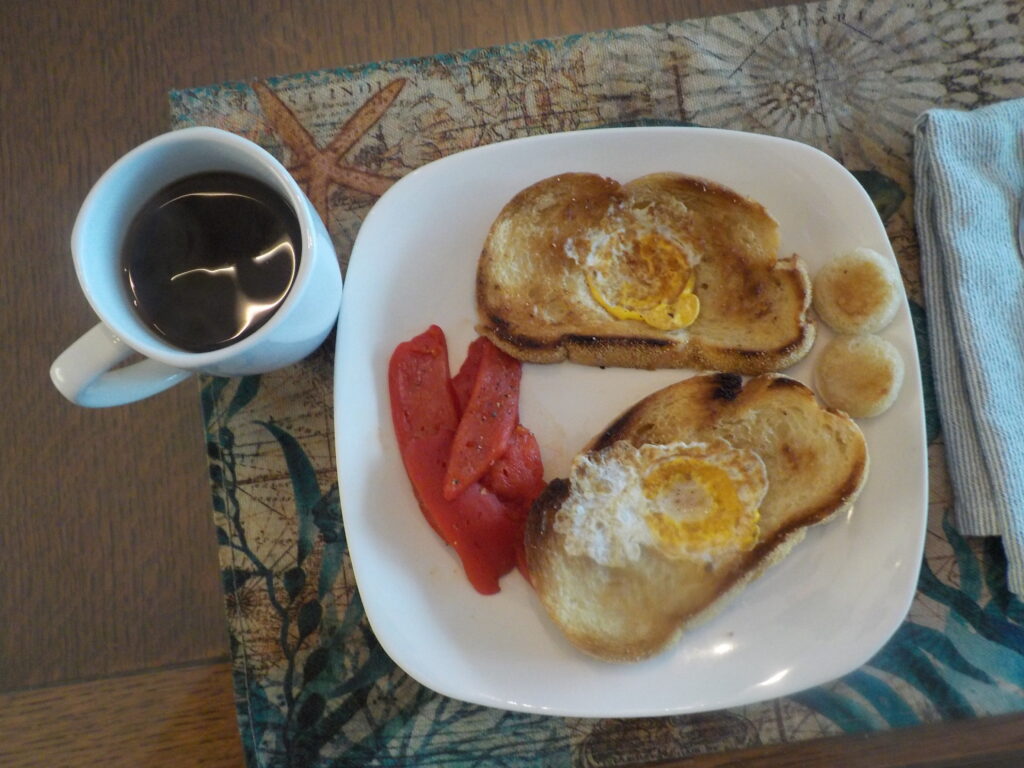
Whereas my mother made this with white Wonder Bread and probably a half a stick of butter, I’ve modified it over the years. One modification came when I first saw the movie Moonstruck in 1987. In one morning scene, Olympia Dukakis is making Uova Fritte nel Pane for Cher. There’s a close up of her flipping the bread in the pan, and you can see that there is also roasted red pepper in the pan that she will top the egg with. I’ve added roasted red pepper to my Bread with the Egg in the Middle dish ever since.
BREAD WITH THE EGG IN THE MIDDLE
Ingredients For 1 serving
- Eggs – 2
- Butter – 4 TBS
- Bread – I sometimes use sour dough instead of Wonder Bread. But a nice thick slice of Italian bread works great as well.
- Roasted Red Peppers – Roast your own or use the ones in the jar. Just make sure that they are whole and not chopped or sliced. I like to use no less than a half of a whole pepper. Sometimes a little over a half, but never a whole pepper. I don’t want to take away from the main event with too much red pepper on the plate.
- Salt/Pepper to taste.
Directions
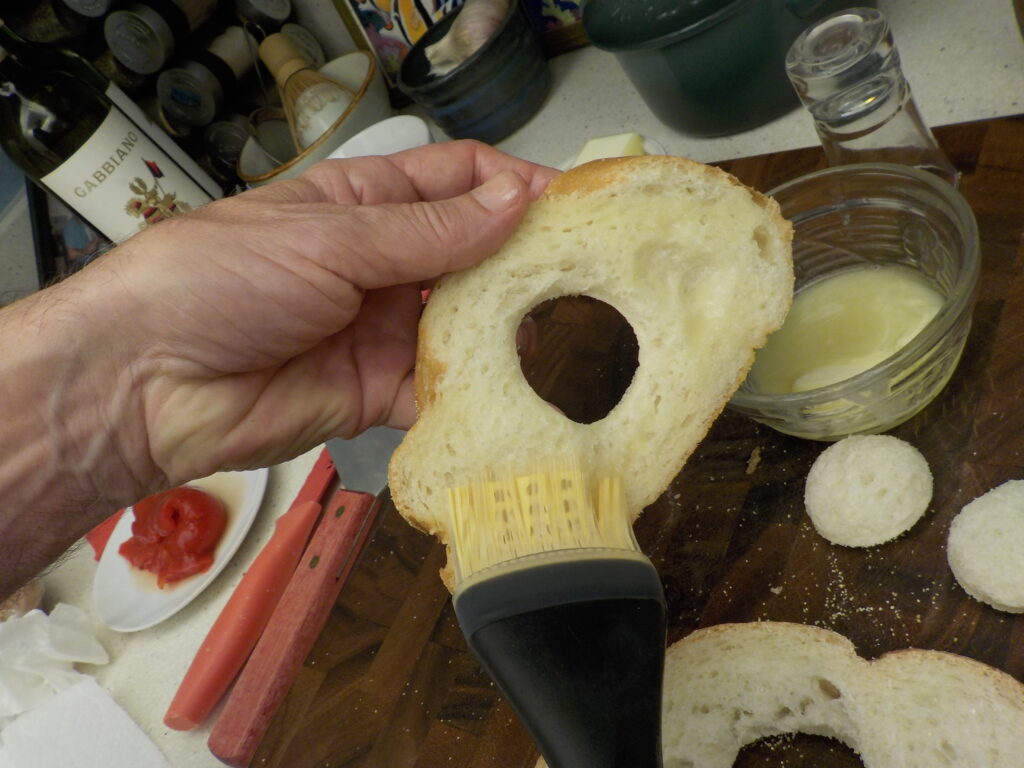
Cut out a round hole in the middle of the bread. I like to use this little liqueur glass that I got at a thrift shop. It makes about an inch-and-a-half hole. Keep the cut outs.
Melt 2-3 TBS of butter and brush liberally on both sides of bread and cut outs
In a cast iron skillet, on low-medium heat (not hot enough to burn the butter), put a couple of tablespoons of butter. Toast each side of the bread and cut outs so that they are lightly toasted brown. You don’t want the bread to finish up crunchy.
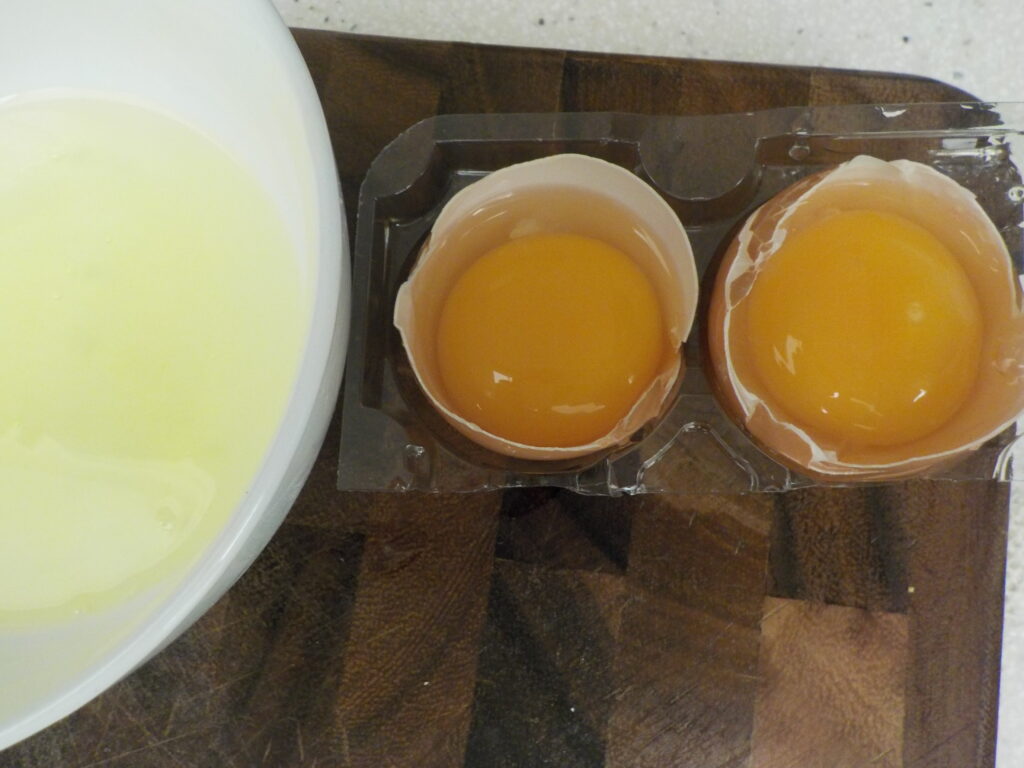
Separate the eggs leaving some whites with the yolks. I don’t like to put an entire egg into the hole. I want the egg (yolk and white) to stay as much as possible in the hole. It might come out into the bread a little, but I would not want the hole egg taking up the bread. Also, keep the separated whites. You might need to add a little into the hole if you didn’t leave enough in the separated yolks. Also, I sometimes like to cook them up right before plating the bread.
Add butter as needed to keep the pan wet. Although you may not want the bread saturated in butter (like my mother used to make), you certainly don’t want a dry toast.
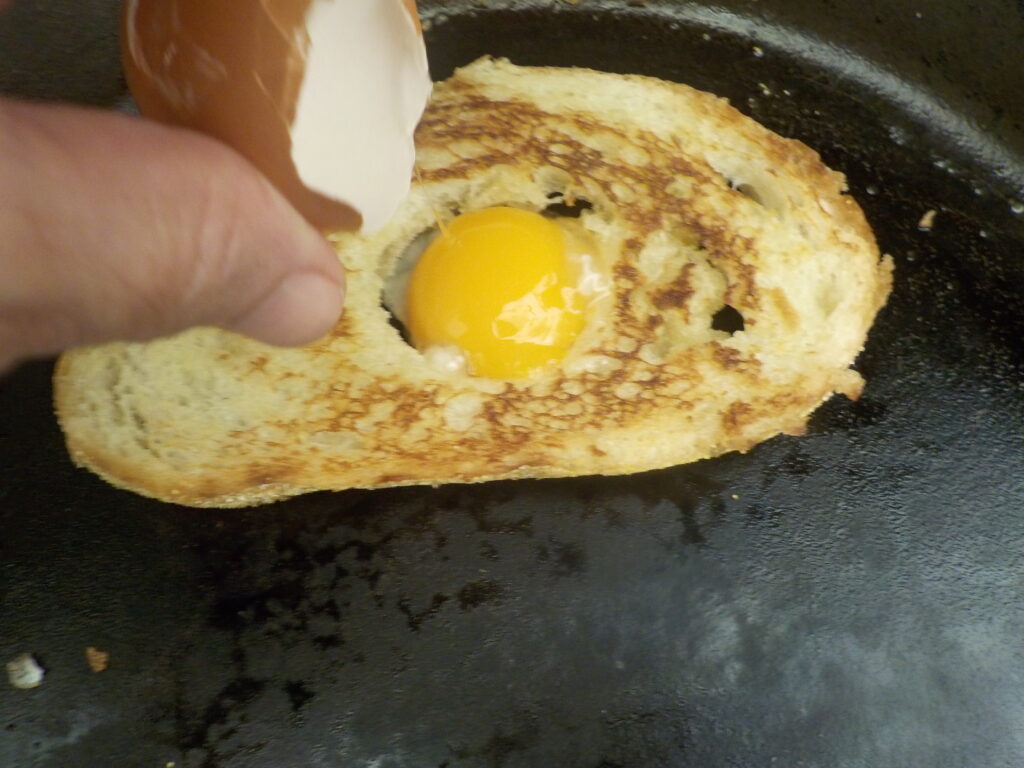
When both sides of the bread and cut outs are toasted to a light brown drop in the eggs. Put a small sliver of butter in each hole. You can probably consider turning off the burner at this point. The residual heat in the pan should be enough to cook the eggs but not brown or burn the whites.
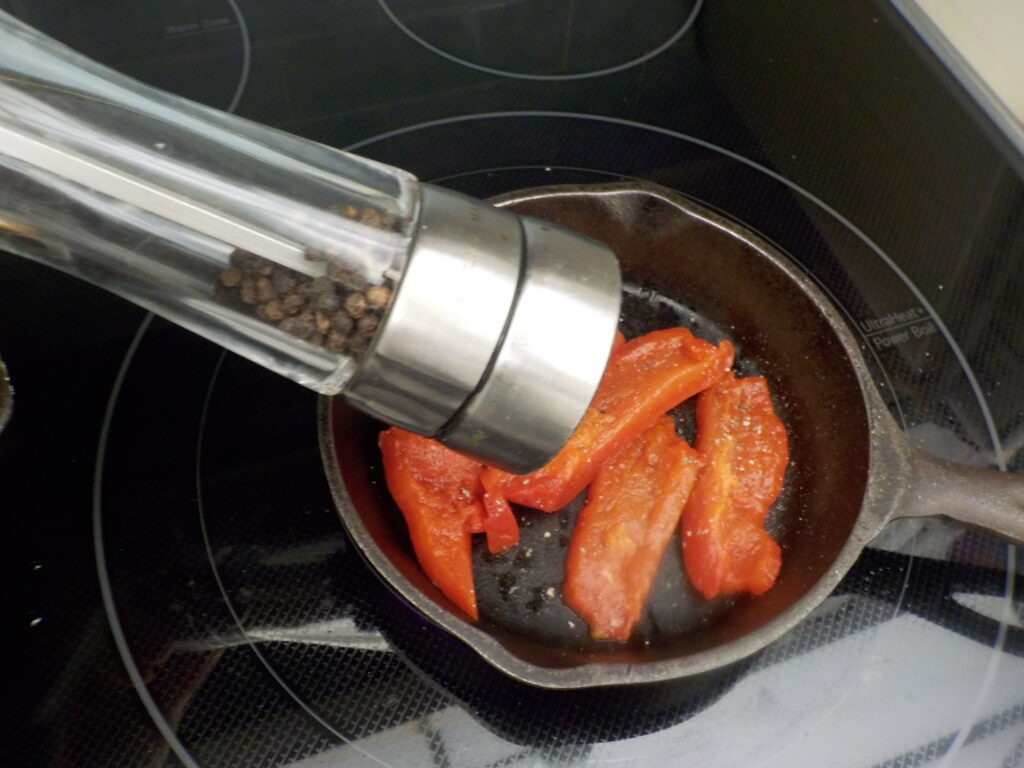
On the sides of the pan, or in a separate smaller pan, heat up the red peppers. Hit with a dash of black pepper.
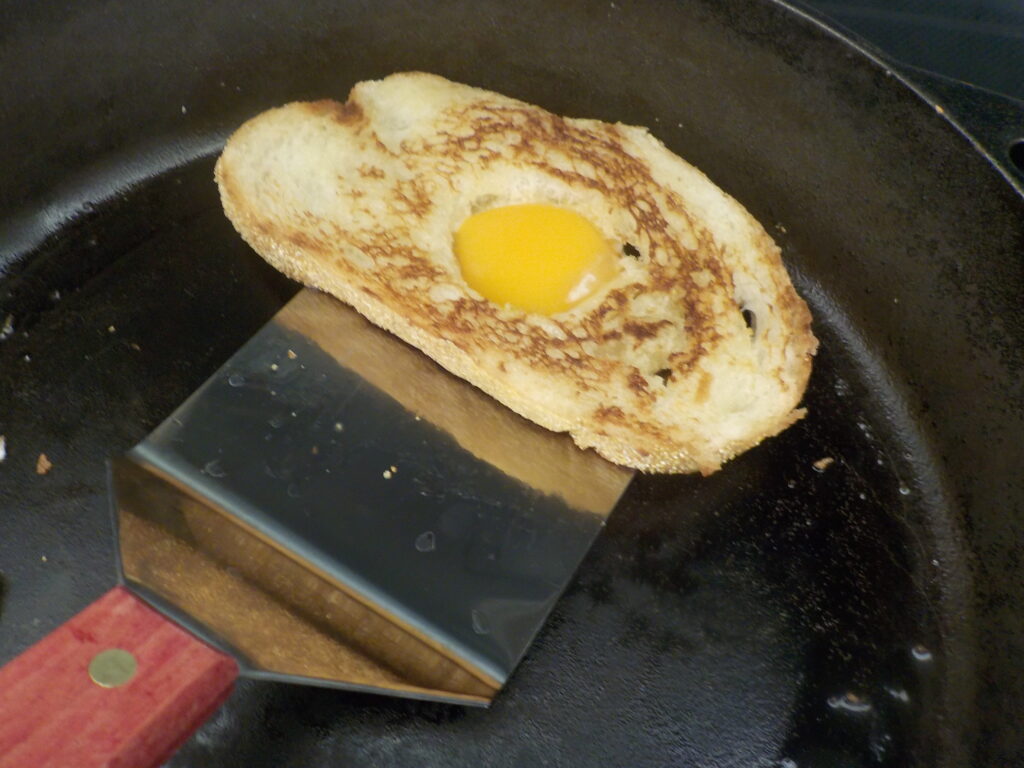
Slide in the eggs. Give a light dusting of salt and pepper. It shouldn’t take more than 5-10 seconds before you get ready to flip. The eggs should be definitely runny when plated, however the whites should be cooked and not runny at all.
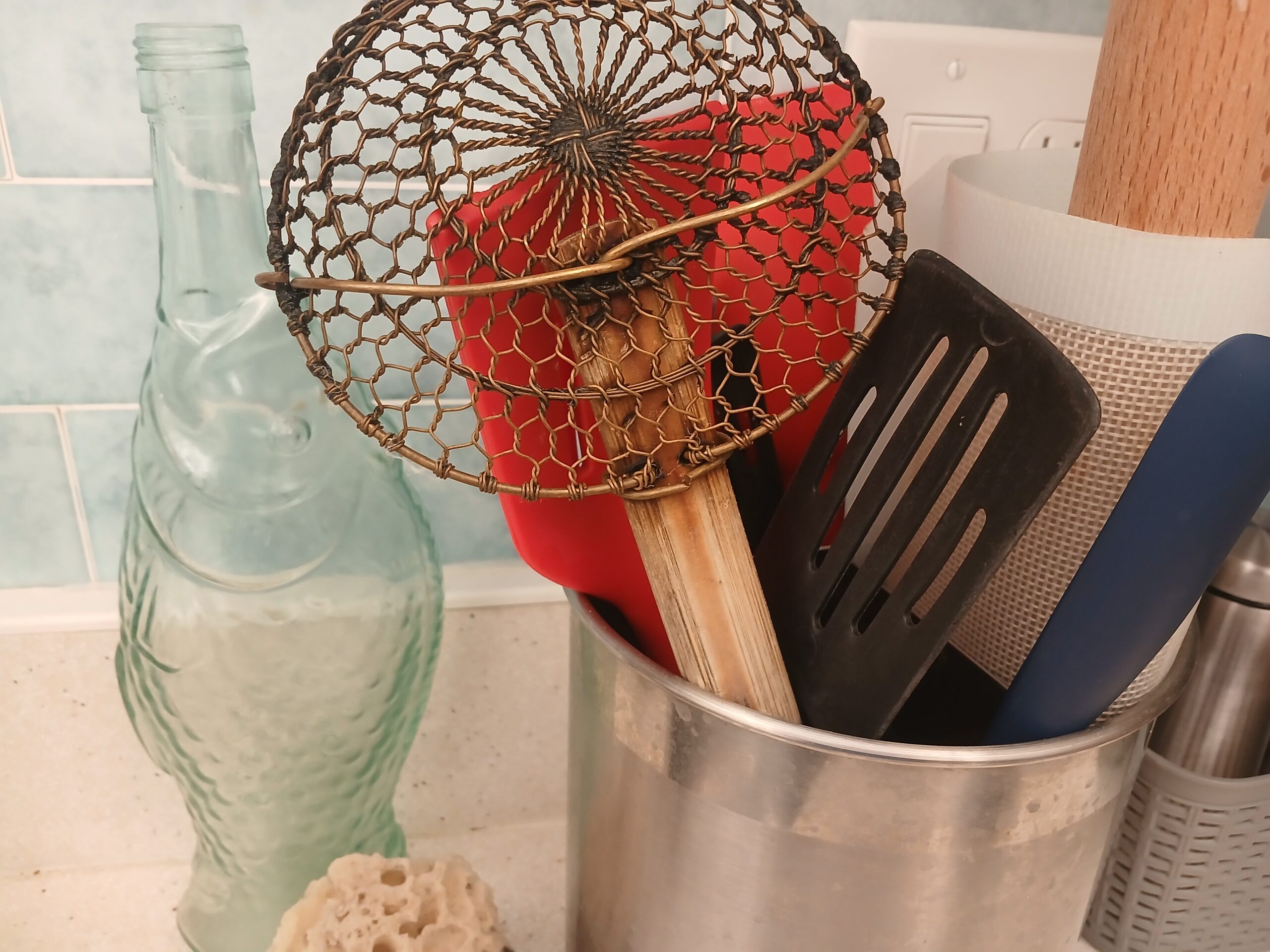
Use a thin bladed metal spatula to flip the bread t o help to minimize breaking the yolk in the process. Absolute best case, the one that you will strive for, is that the bread gets flipped without the yolk breaking. Flip the bread and give another tiny hit of salt and pepper to your taste.
Another 5-10 seconds and you should be ready to plate.
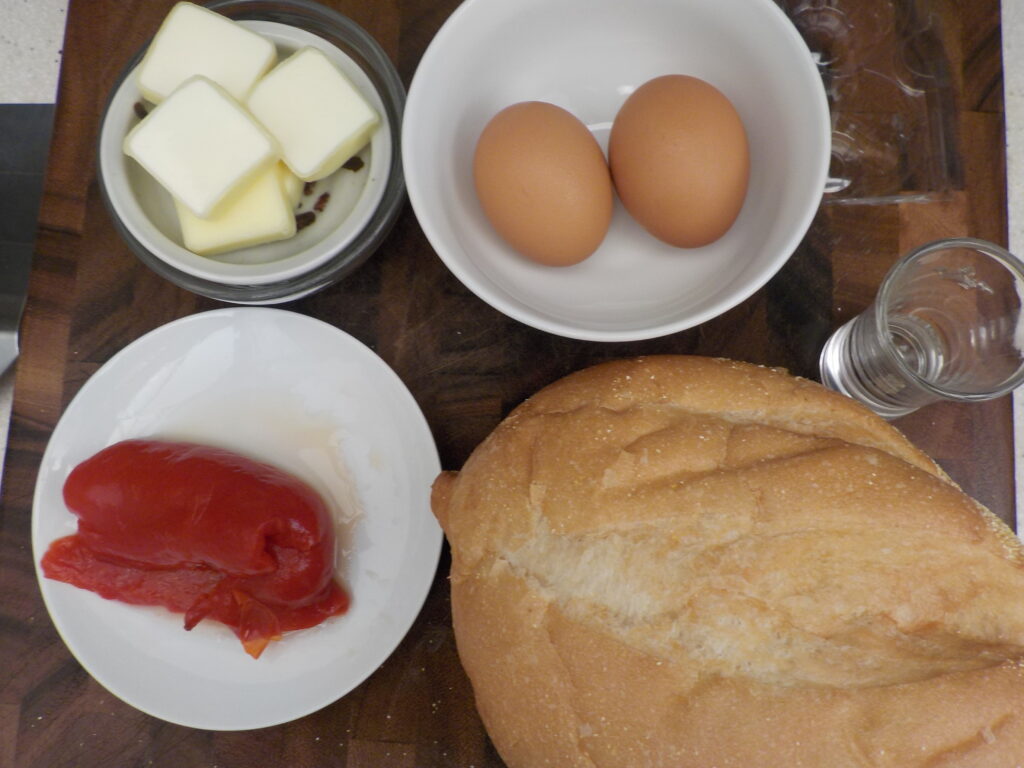
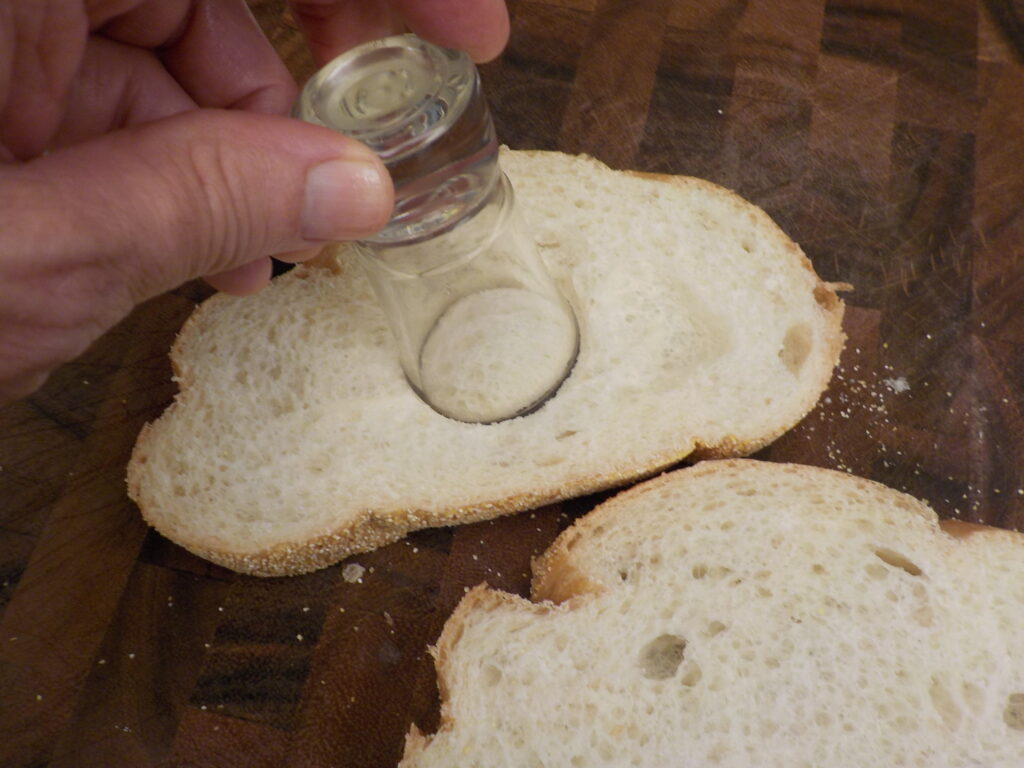
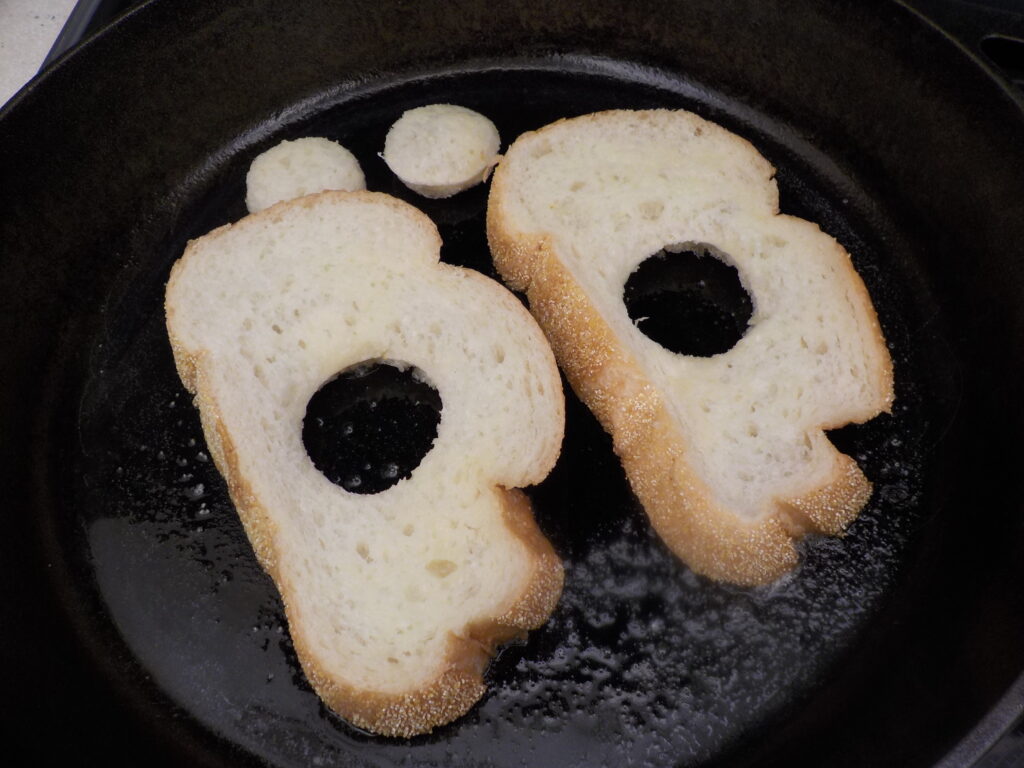
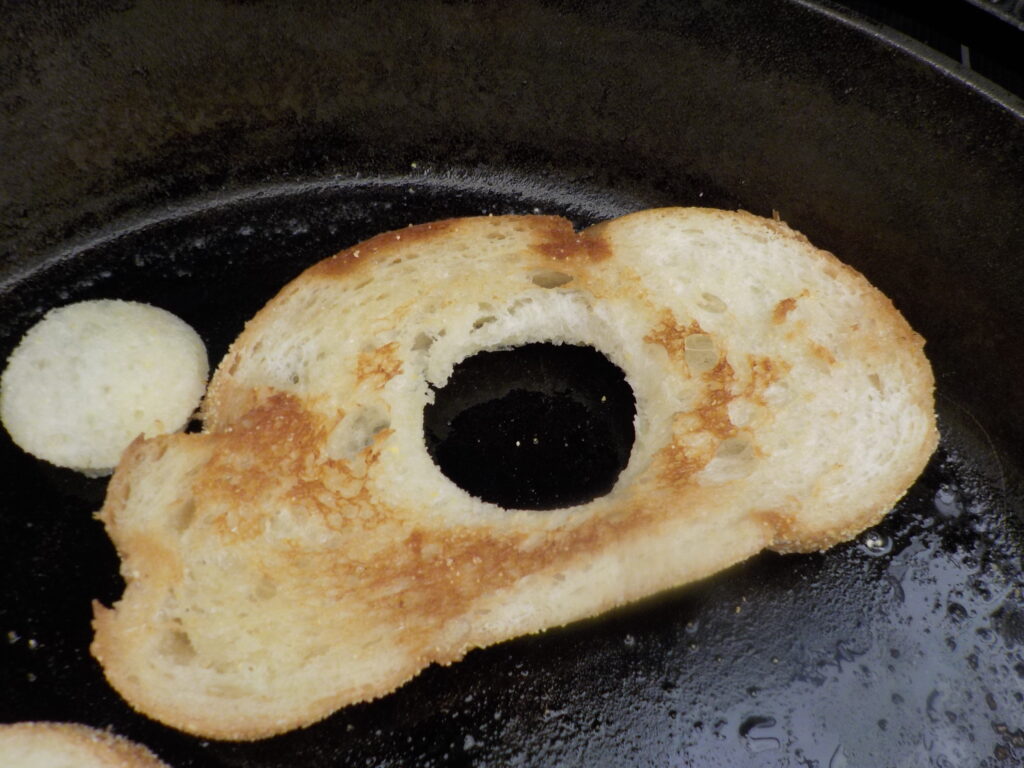
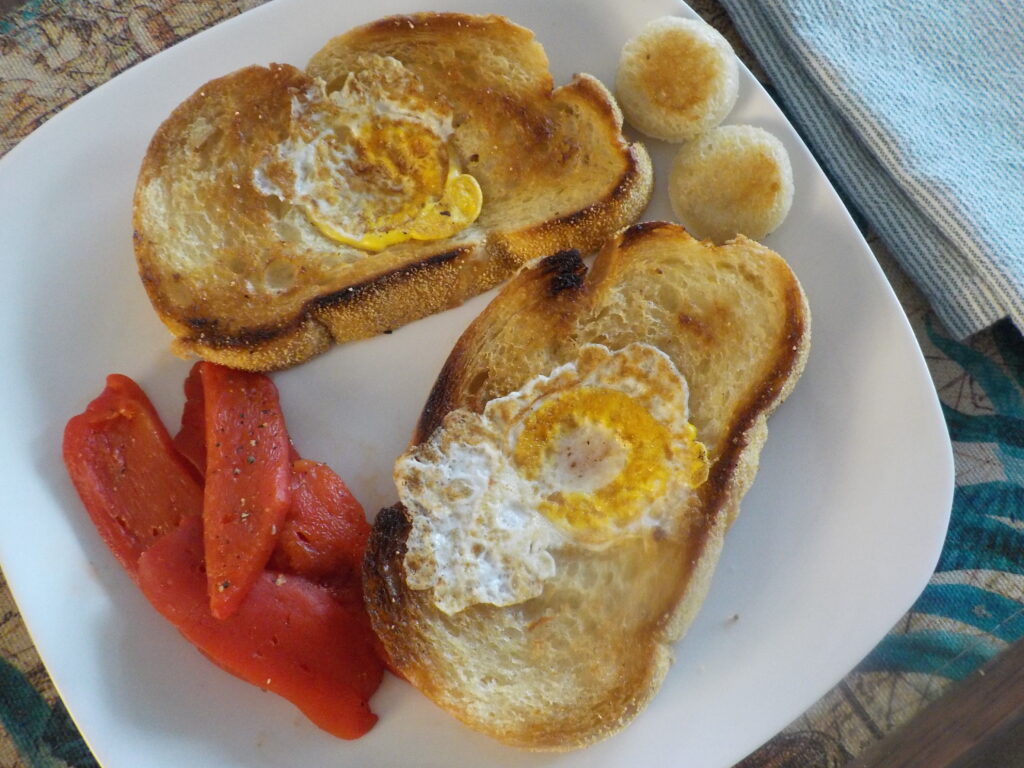
Put bread and cut outs on a plate. Add the heated red pepper to the side of the plate. Don’t eat the cut outs first. Save them for after you’ve eaten the bread to sop up any leftover yolk on the plate.
Optional: As you are plating, sprinkle the separated whites from the beginning of this recipe with a little salt and pepper, maybe some oregano and cook quickly in the cooling pan that you cooked the bread in.
Nanna’s World Famous Olive Salad
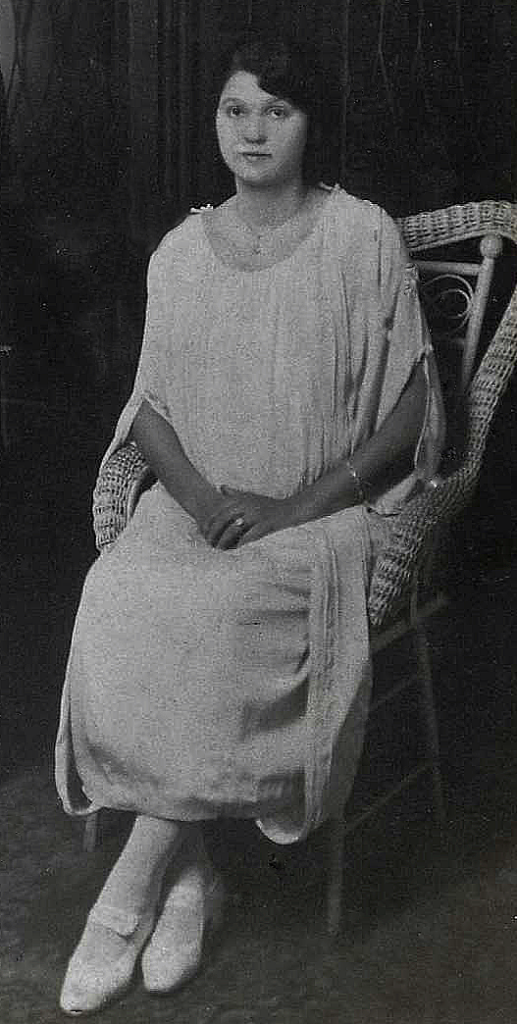
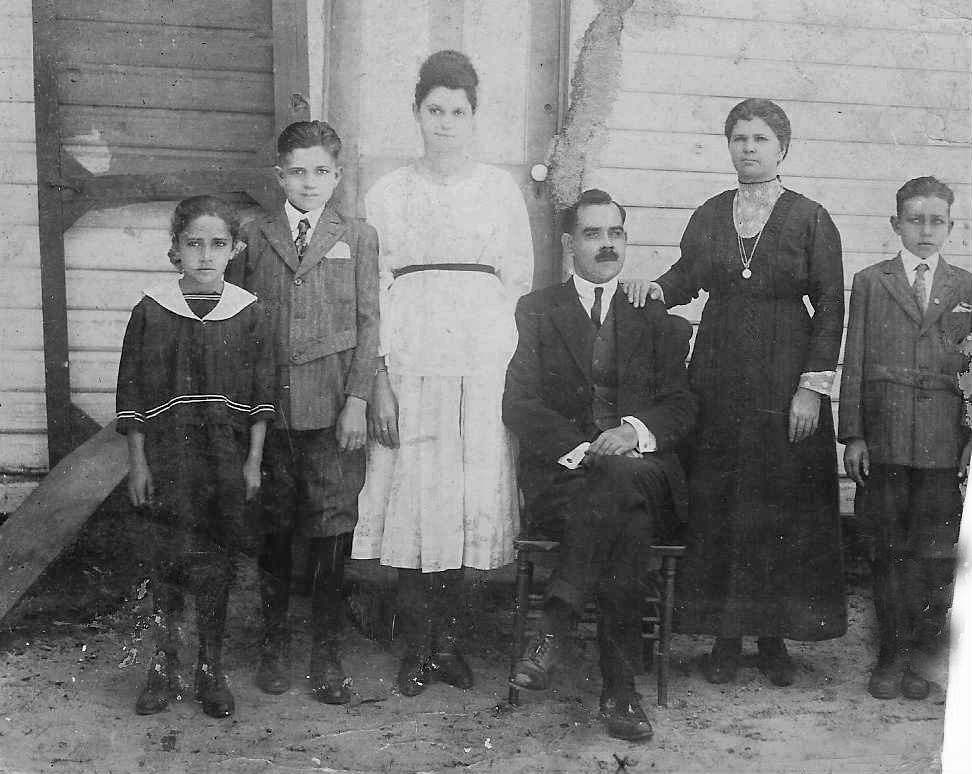
My father’s family came to America from Sicily in the mid to 1800’s. They came from Santo Stefano di Quisquina. My father’s mother’s family came from Allesandro Della Rocca. My mother’s family came to America by way of Cuba.
Early on, they lived, worked and played in Ybor City, Florida. Some were cigar makers, grocery store owners, farmers, garment factory workers, machinists and carpenters.
The way that they cooked has changed between the 1800 and 1900’s and now. However, the food that they ate has remained pretty much the same.
Cooking in Ybor City has ranged from wood, charcoal and one-burner kerosene stoves to more modern gas and electric. But throughout these transitions my Sicilian grandmother’s mother, Nanna Justina, still baked bread in her back yard wood burning red brick oven.
My father’s family came to America from Sicily in the mid to 1800’s. They came from Santo Stefano di Quisquina. My father’s mother’s family came from Allesandro Della Rocca. My mother’s family came to America by way of Cuba.
Early on, they lived, worked and played in Ybor City, Florida. Some were cigar makers, grocery store owners, farmers, garment factory workers, machinists and carpenters.
The way that they cooked has changed between the 1800 and 1900’s and now. However, the food that they ate has remained pretty much the same.
Cooking in Ybor City has ranged from wood, charcoal and one-burner kerosene stoves to more modern gas and electric. But throughout these transitions my Sicilian grandmother’s mother, Nanna Justina, still baked bread in her back yard wood burning red brick oven.
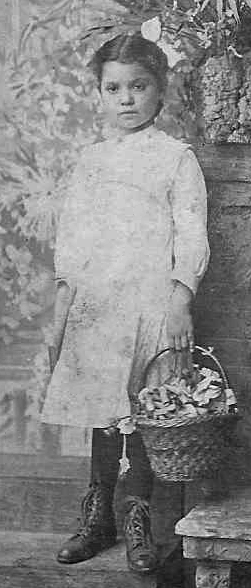
In my father’s family’s house meals were served on a long wooden table. Nanno Benedetto, my grandmother’s father (any my father’s and my namesake) presided over dinner at the head of the table where he alone dispenses his mod-mad wine from a gallon jug that was kept on the floor next to him during dinner.
The main foods at this table included home-made pasta (“…first you get the dough and make it round. Then make it flat like a pancake, with a rolling pin… finito, finito. You roll it like a jelly roll cake and cut it however big or small you want the pasta to be. Then you hang it on a broom until it dries.” With pasta as the base, there was “succo” (tomato sauce), various meats; chicken, sausage, roast, fresh vegetables (many from Nanno Bennedeto’s garden), all kinds of soups (lentil, escarole, chicken) and olive salad.
My Sicilian grandmother, Nanna Antonia, learned how to shop, cook and bake bread from her mother, Justina. She was also taught how to make her “World Famous” (as we liked to call it) Olive Salad. It was made the same way for generations except for the onions. When my grandmother taught me how to make olive salad, she said “we used to fry some of the onions. But now, it’s too much trouble…” Not too much trouble for me. I don’t “fry” the onions, but I sweat about half of them leaving the other half raw.
When I was a little kid and we would go to my grandmother’s house for a Sunday dinner, this was the usual stuff that would come to the table; It started with peanuts. The first thing on the table, while she was still cooking at the stove, were little bowls of plain peanuts. Then little bowls of salami and/or peperoni would appear. Assorted cheeses began to hit the table. I guess these would be considered apps today. At this point there was no formal seating. Guests would pass by the table and pick up a couple of fingerfuls of peanuts, cheese and salumi. Finally, right before the main courses were set out, bowls of my nanna’s World Famous Olive Salad would come out.
A call to sit at the table and you could first get a bowl of Escarole Soup with little meatballs about three-quarters of an inch in diameter that were cooked in the soup. Bowls taken away and plates appeared. Pasta would go on the plate. Next up the sauce (succo) on top of the pasta. Then bowls of meat were put on the table. This included one or more of the following; meatballs, sausage, chicken, beef chuck roast, short ribs, etc. Some of the meat had been cooked in the sauce for flavor. However, the meat was usually served separate from the sauce.
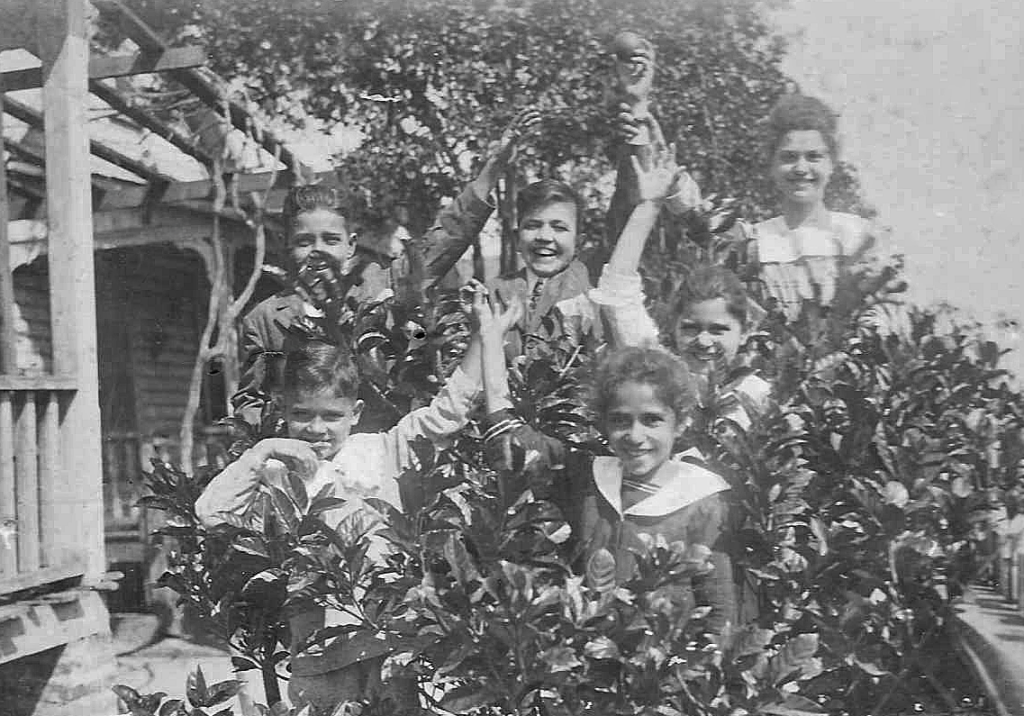
As a much sought after prize, you could get a piece of potato or hard-boiled egg that was cooked in the sauce. I was told that the potato was put in the sauce “to soak up the acid” from the tomato sauce. However, whoever was luck enough to get a piece of the potato ate it with glee, consuming the now concentrated acid anyway. I think that the potato and eggs were likely a carry over from leaner times when maybe meat was expensive and adding the less costly potato and eggs to the sauce acted as filler to whatever meat could be afforded.
Desserts were not elaborate; ice cream, cookies, chocolate, various pastries. Of course espresso or coffee as well.
But for me, as delicious as everything was, the olive salad was my absolute favorite. The pungent aroma of olive oil and vinegar as it has steeped into the olives. The sweetness of the onions. The green tasting crunch of the celery. The surprise soft texture of the occasional marinated artichoke.
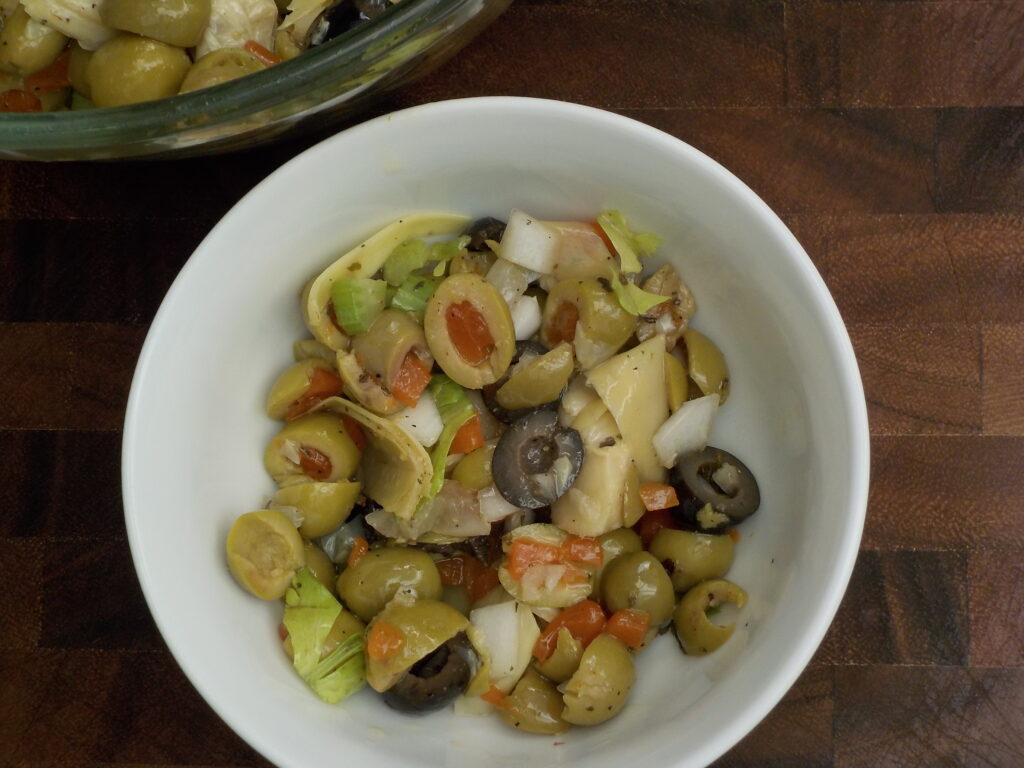
My love for the olive salad was so renowned that one Sunday my grandmother played a joke on me. A rarity. I was probably around five or six-years-old. As the usual peanuts and salumi where hitting the table, I anxiously awaited the bowls of olive salad. They did not appear when I thought that they should have. I wandered around doing kid things with my cousins, but occasionally I would come by the table to check on the olive salad. Still a no-show. How could this be, I thought to myself. I asked my mother about it and she said that I should go ask Nanna. So, I did. “Nanna. Where’s the olive salad?” “Oh…”, she said “I didn’t have time to make it. We don’t have any olive salad today.” I was heart broken. Never one to have a good poker face (to this day), the look of extreme disappointment on my face must have been obvious and priceless to someone playing this cruel trick on me (my very own sweet and loving grandmother!). Nanna just walked away. As I stood there in place, not having moved, trying to process how this could be, Nanna returned with a big bowl of olive salad. “I was just kidding.” she said. Of course. It would have been impossible to have a Sunday dinner at Nanna’s without olive salad. My umbrage at the cruelty of the “joke” quickly went away as I dug out a heaping spoonful of the manna-like olive salad.
This olive salad was more than likely responsible for the first igniting of my tastebuds. And every time that I make it, I can’t help but think about my great, great grandmother, Grazia, aka Donna Julia, who was a renowned practical joker (but that’s another story), who taught her daughter, Justina, who taught her daughter, Antonia (my grandmother) who taught me, who taught my daughters how to make this version of Nanna’s World Famous Olive Salad.
RECIPE FOR NANNA’S WORLD FAMOUS OLIVE SALAD
Ingredients (Approximately 32 oz of salad) Start with the following. Adjust as needed
- Onion – 1 CU
- Celery – 1/2 CU
- Green Olives, whole (pitted) – 16 oz
- Black Olives, whole medium (pitted) – 6 oz
- Artichoke Hearts (marinated or not) – 4 oz
- Fennel (leaves and/or crushed seeds) – 1/4 tsp
- Garlic (crushed) – 2 medium cloves or if in dire straits, 1/8 tsp garlic powder
- Basil – 1/2 tsp
- Oregano – 1/2 tsp
- Pepper – 1/8 tsp
- Salt – None. Olives should add their own saltiness
- Vinegar – start with 3 TBS
- Olive Oil, Extra Virgin – start with 4 oz
- Wine, white – 2 TBS
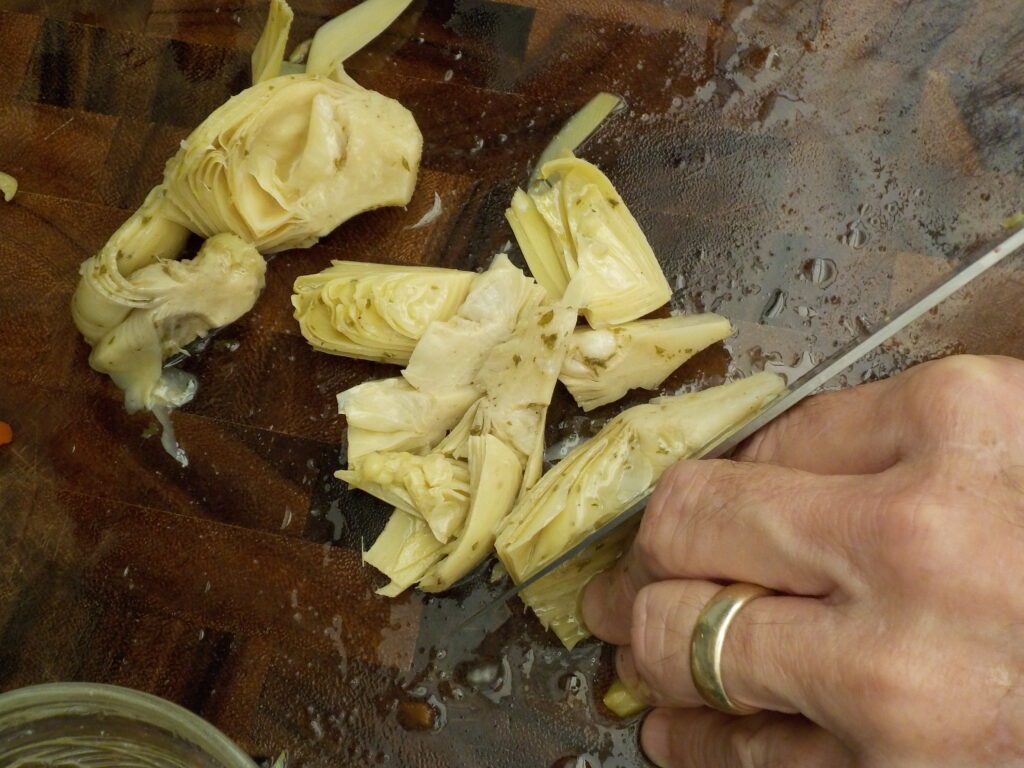
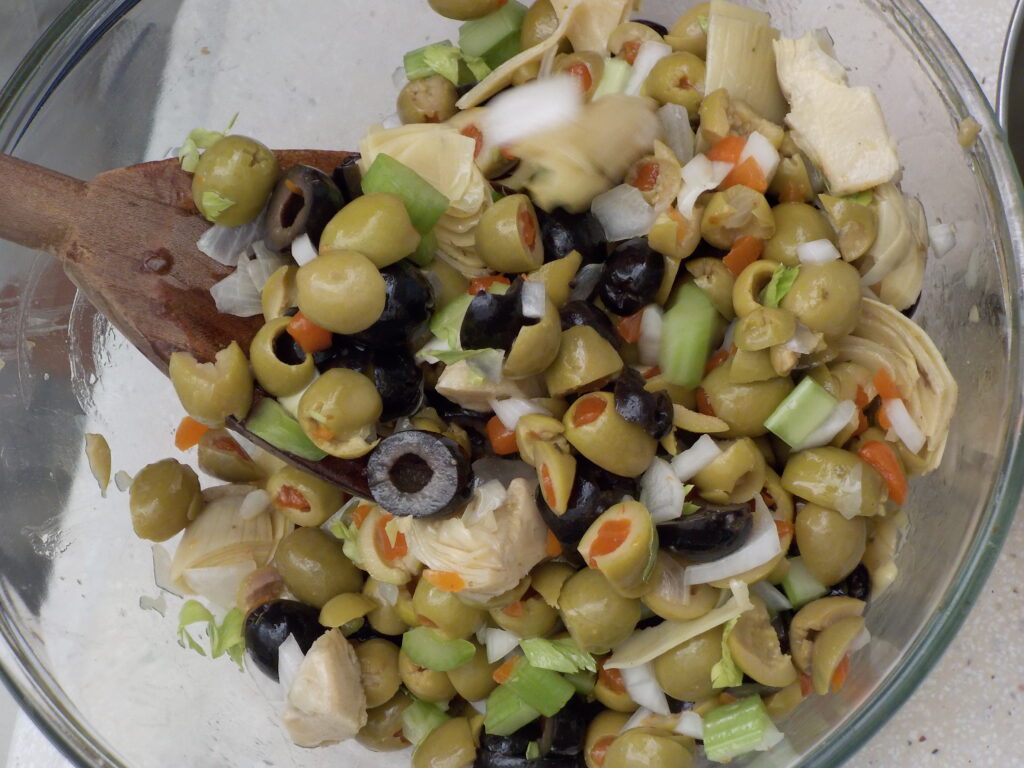
Right before pouring dressing onto the olive mix, make sure to whisk dressing so that it is full mixed. Pour dressing into the olive mix. Pour a little at a time and mix thoroughly with wood spoon. Check to make sure that all ingredients are covered with dressing, but not too much so that the dressing pools too much in the bottom of the bowl.
Serve as a side salad with any meal or as an antipasto. You can chop some of the salad a little more finely and use as a spread on sandwiches or on Cuban or Italian bread or as a bruschetta topping.
Preparation
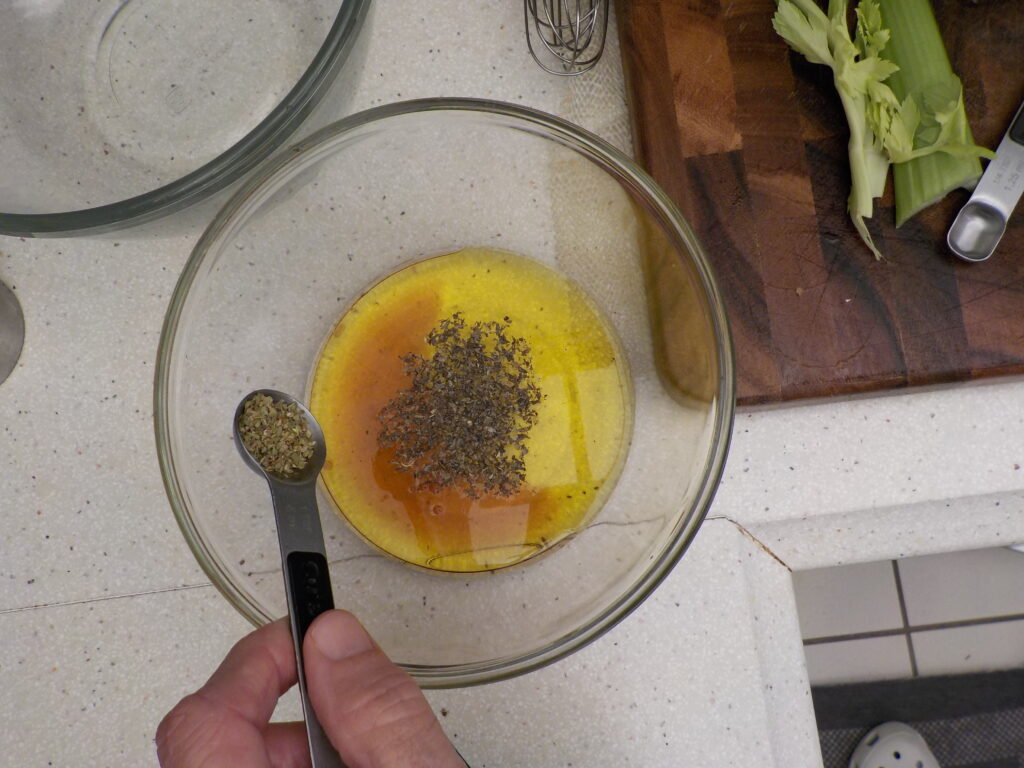
Dressing – Taste as you add smaller portions of the olive oil, vinegar, herbs, garlic, pepper in a small glass bowl. Most importantly, the vinegar and wine should not over power the olive oil. But, it can’t taste like it’s all olive oil. You need a good balance of oil, vinegar and wine. When you’ve got it right, whisk and let sit.
Mix (with a wood spoon) the olives, artichokes, onion and celery in a large glass bowl. The olives should make up the majority of the salad. The onions, celery and artichoke hearts are there for support. As you mix these ingredients, take a look at the colors. You should see mostly the green olives, a lesser amount of black, a smaller amount of white from the onions. Celery should be about equal with the amount of onions. The artichoke hearts should be minimal and isolated making for a rare “surprise” when the salad is served in individual portions.
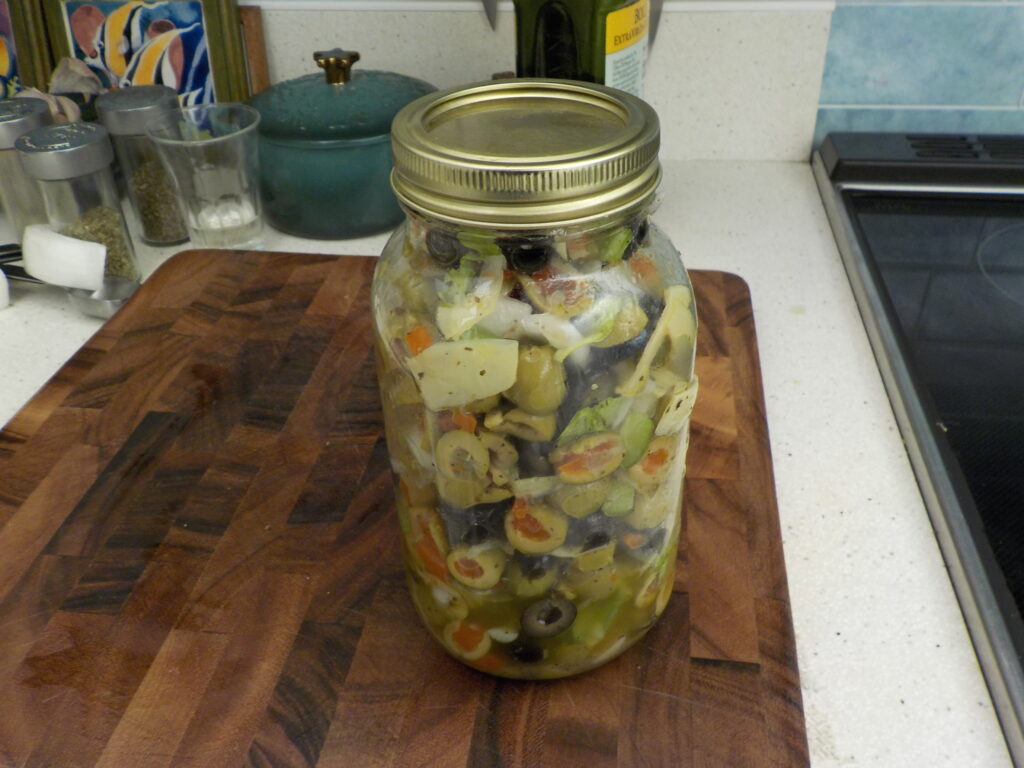
Place dressed salad into glass jars. Use empty olive jars from this prep and other jars saved from previous making of the salad. Or a mason jar works great too. When transferring the salad to storage jars, use a slotted spoon to make sure that there is not too much dressing going into storage.
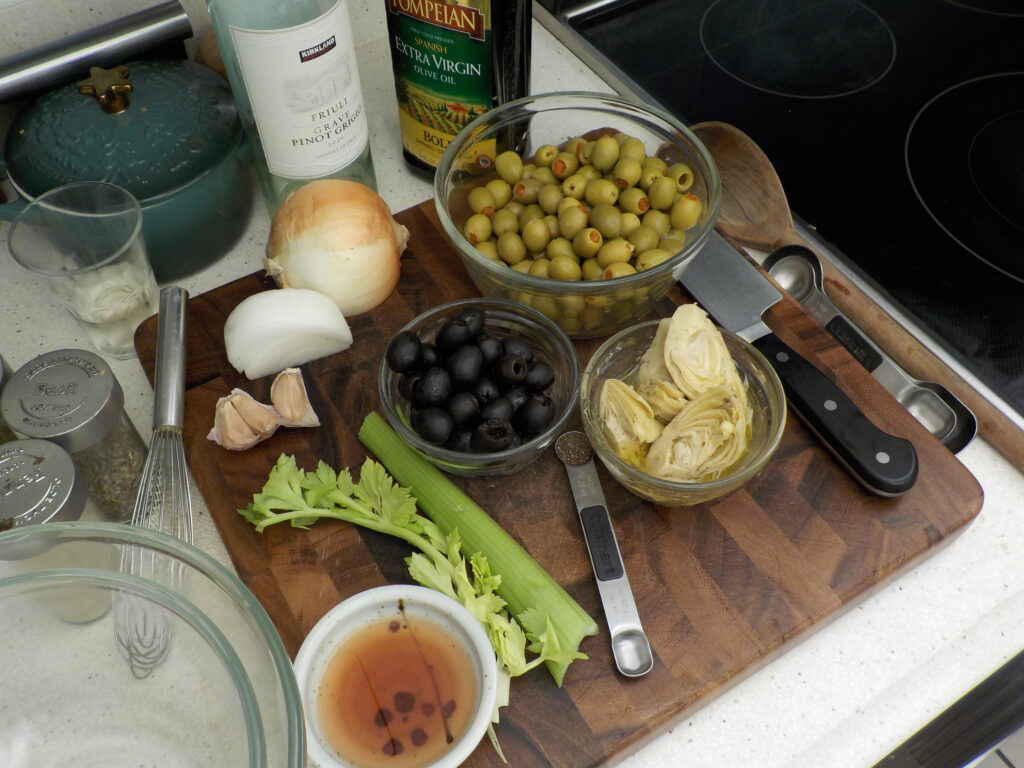
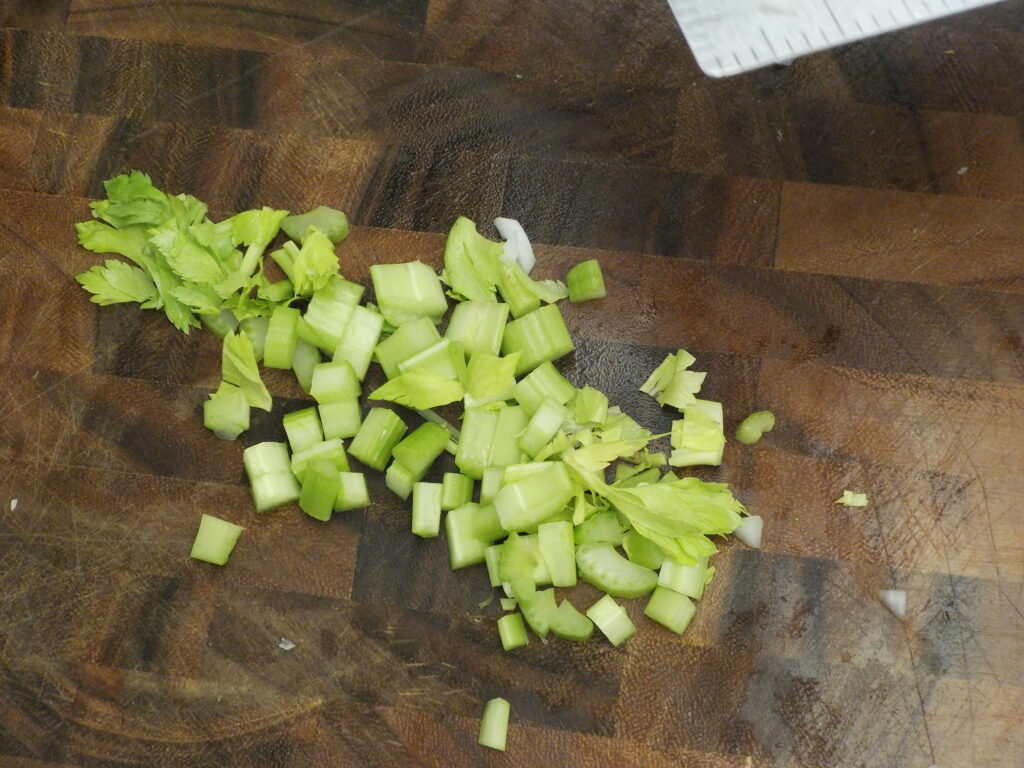
Rough cut the olives, onions and celery. Try not to make uniform pieces. Don’t use a food processor. Quarter the artichoke hearts. Celery – make sure you have some celery leaves included in the mix. Onions – For historic version, sweat half of the onions until just not-raw.
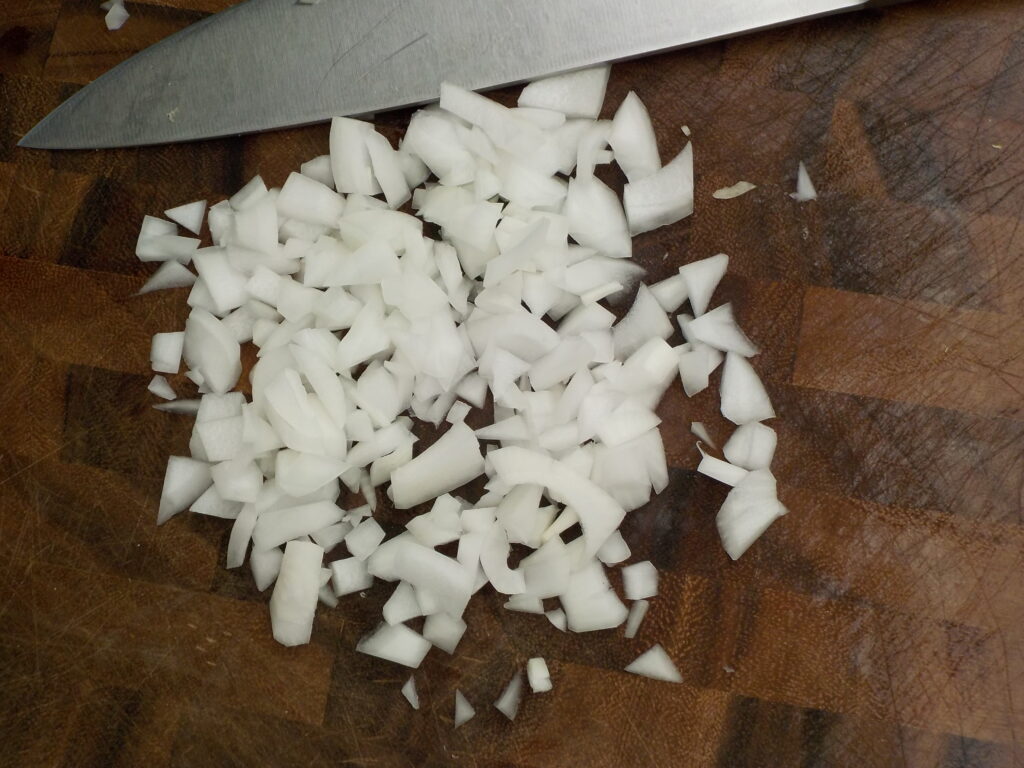
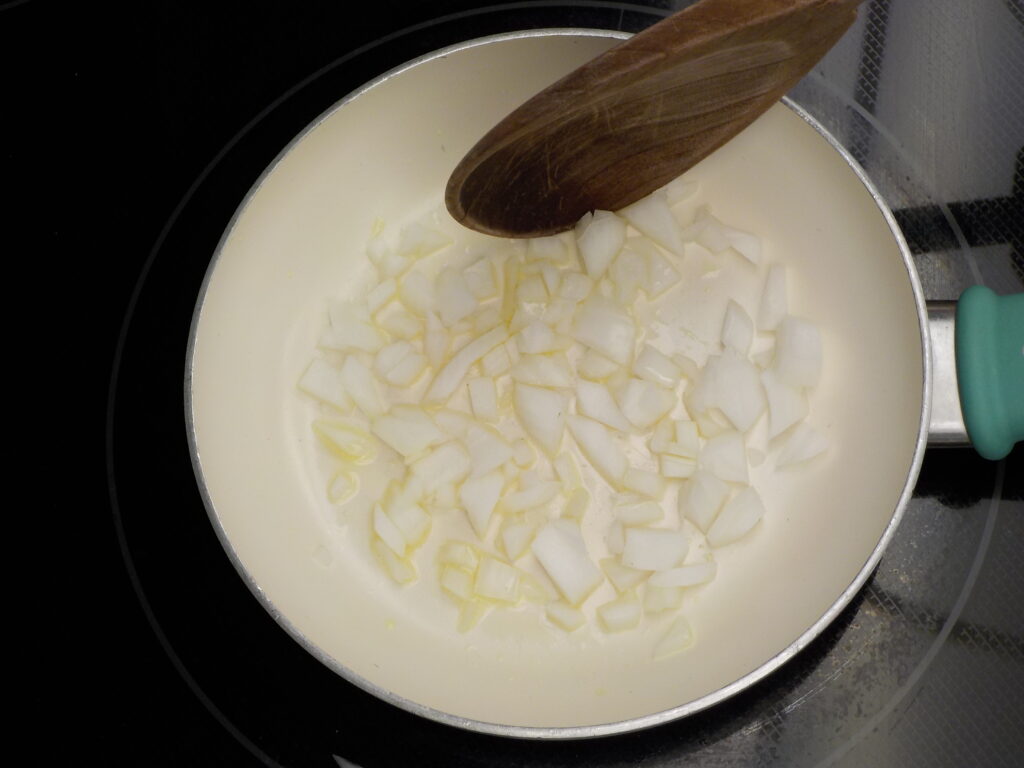
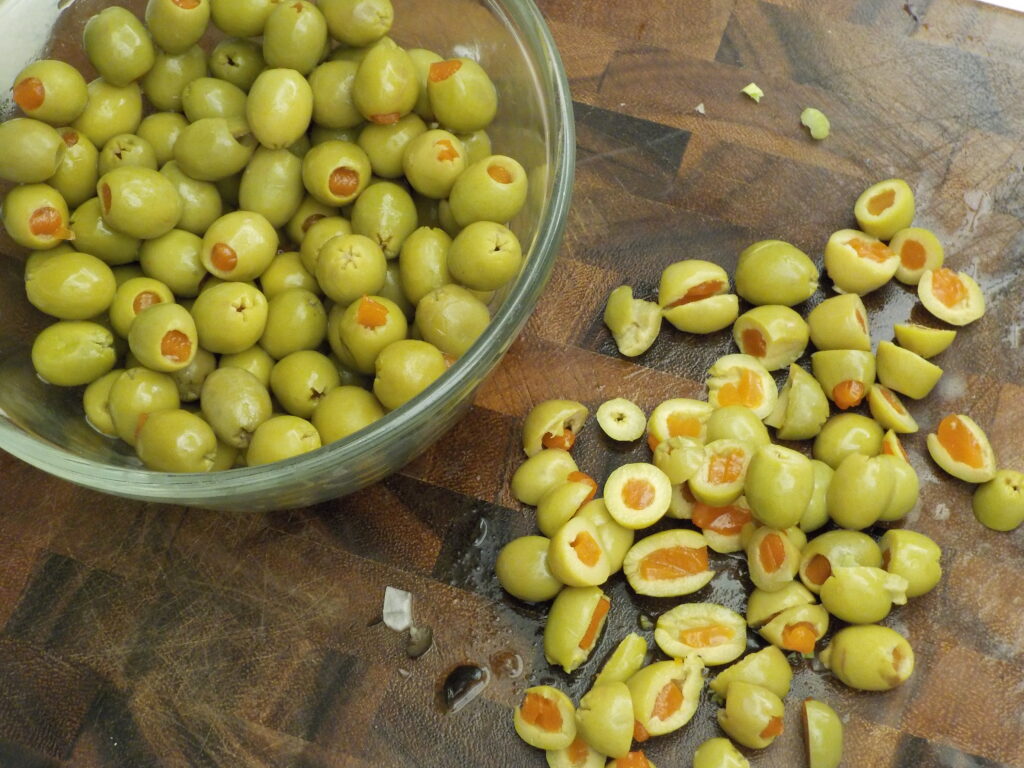
Let marinate in the refrigerator for a few hours (if you can). Typically day 2 servings become extremely savory. If leaving overnight, make sure to shake the jars every once in a while to make sure that the olives, et al stay coated.
Cauliflower with Peppercorns
I decided to see what I might be able to make for lunch with ingredients and left overs on hand. Here’s what happened.
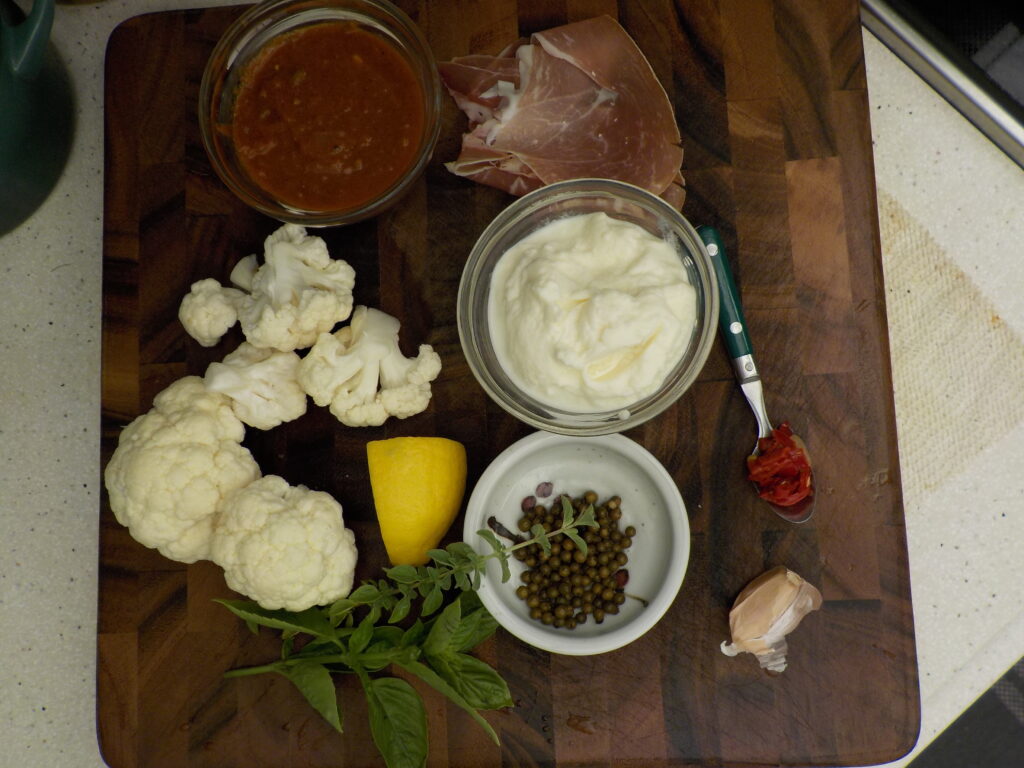
Ingredients – 1 serving
- Cauliflower – 1-2 CU
- Green Peppercorns or capers – 1-1/2 TBS
- Roasted Red Pepper – 1 whole
- Red sauce – 2 TBS
- Red chili peppers – 1 tsp
- Serrano Ham (optional) – 2 slices
- Garlic – 1 large clove
- Ricotta – 6 oz
- Lemon – Juice 2 TBS
- Basil and oregano – Best if fresh
- Salt/Pepper to taste
Directions
Prep
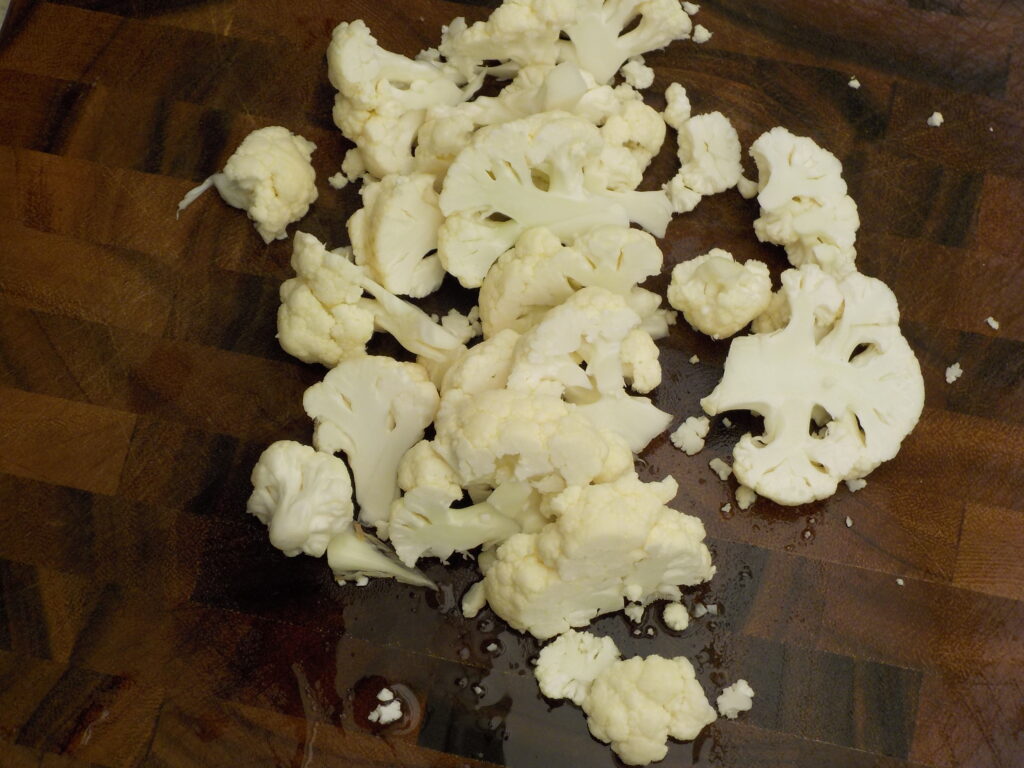
- Cut cauliflower into florets, then slice the florets into 1/4 slices
- Red pepper into 1/2 slices
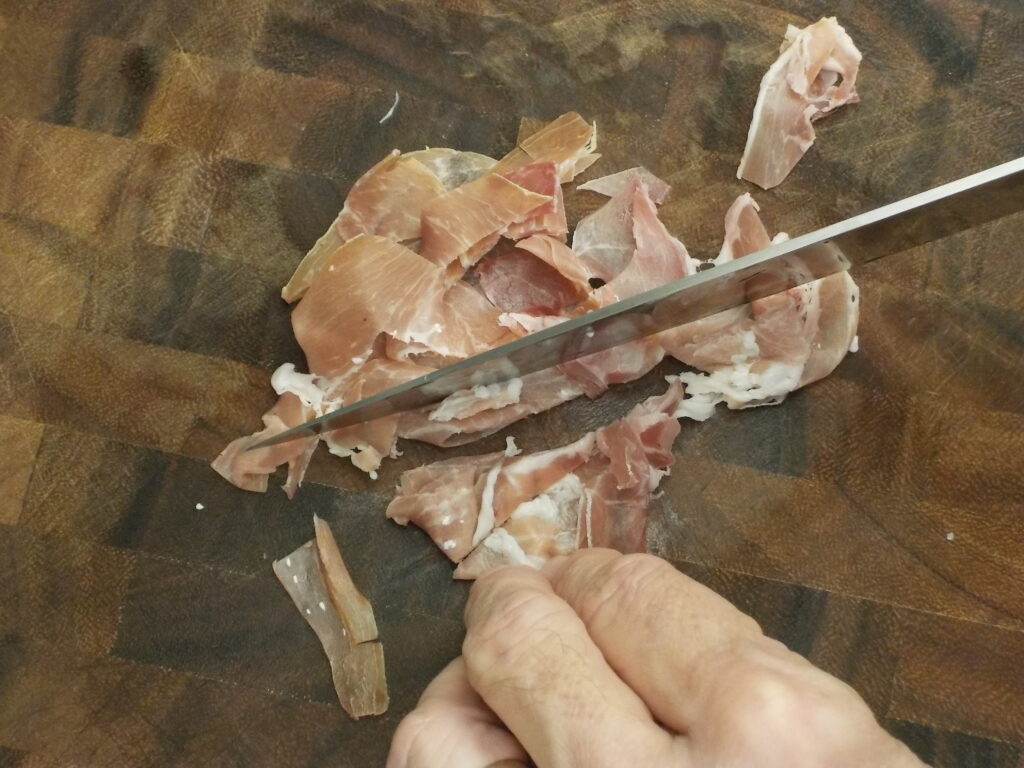
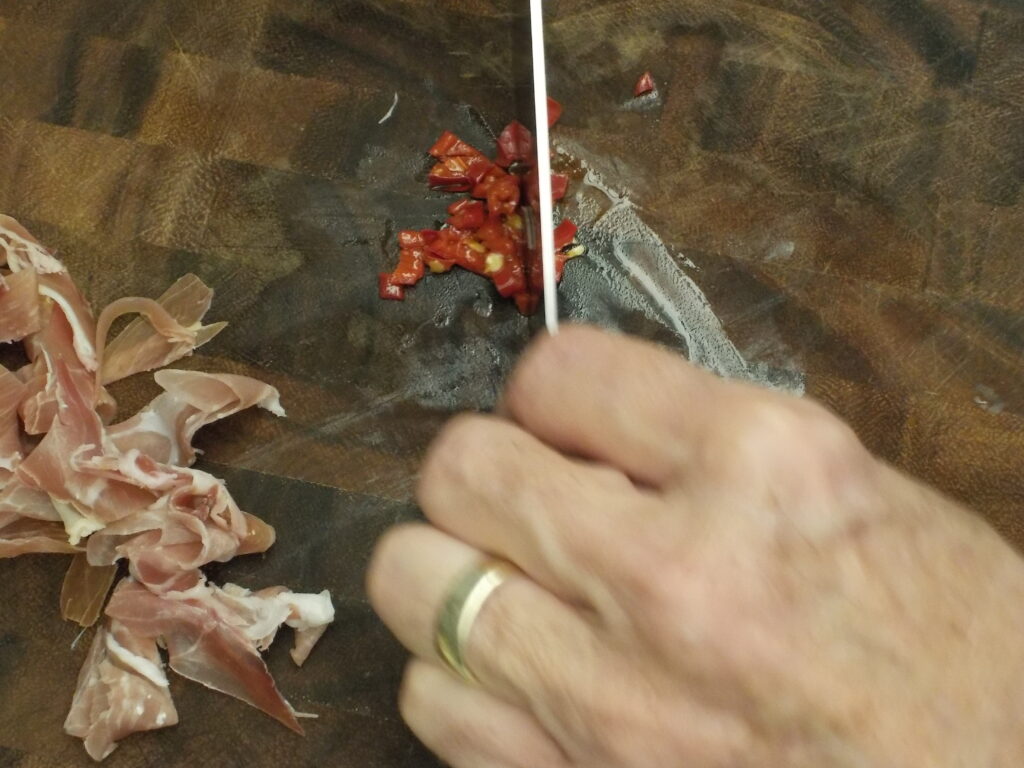
- Serrano ham into 1/2 pieces
- Smash or mince the garlic
- Finely chop red chili pepper
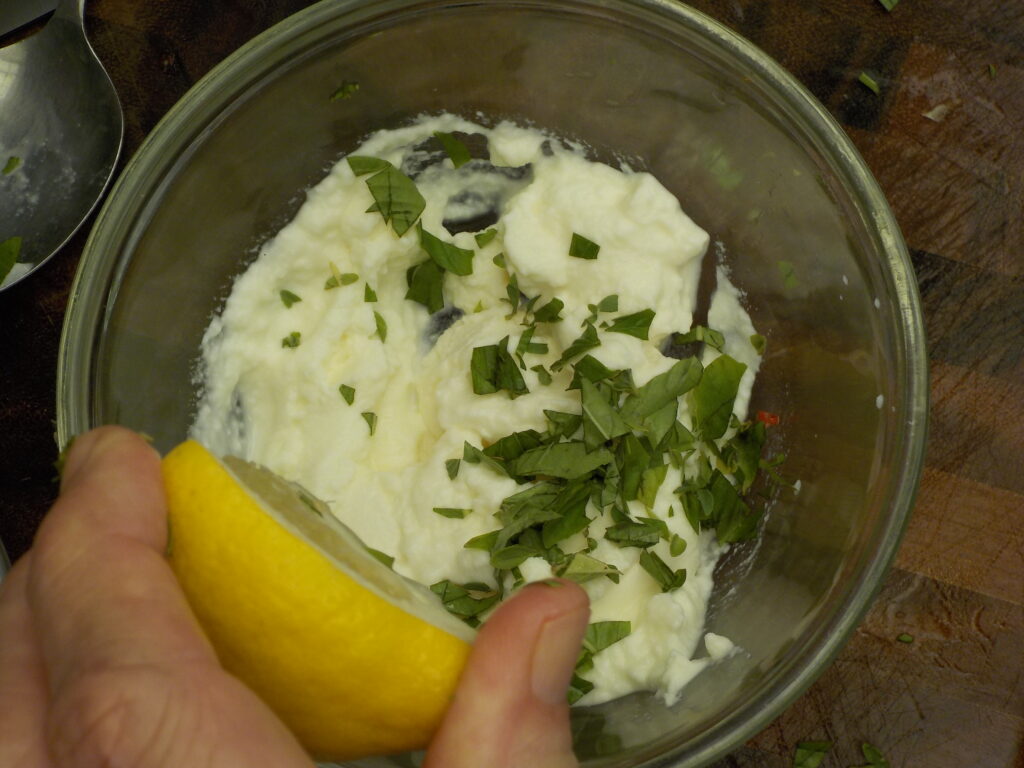
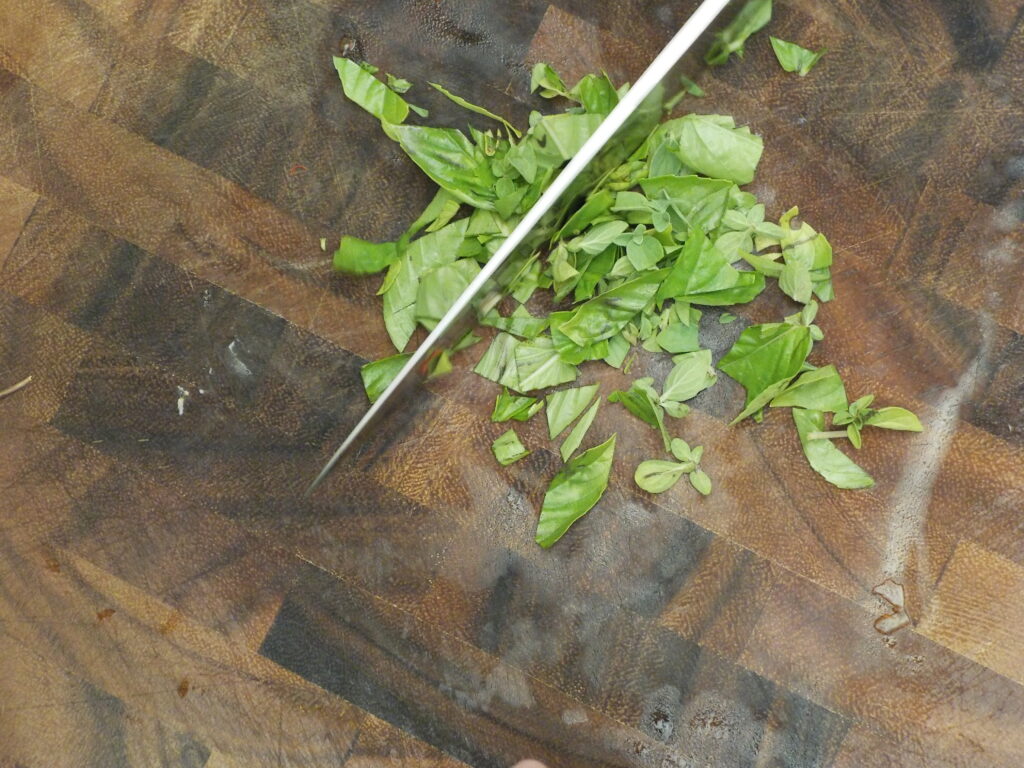
- Ricotta – Mix ricotta with lemon juice and about a table spoon each (if fresh) basil and oregano. A little salt and pepper to taste.
Plate
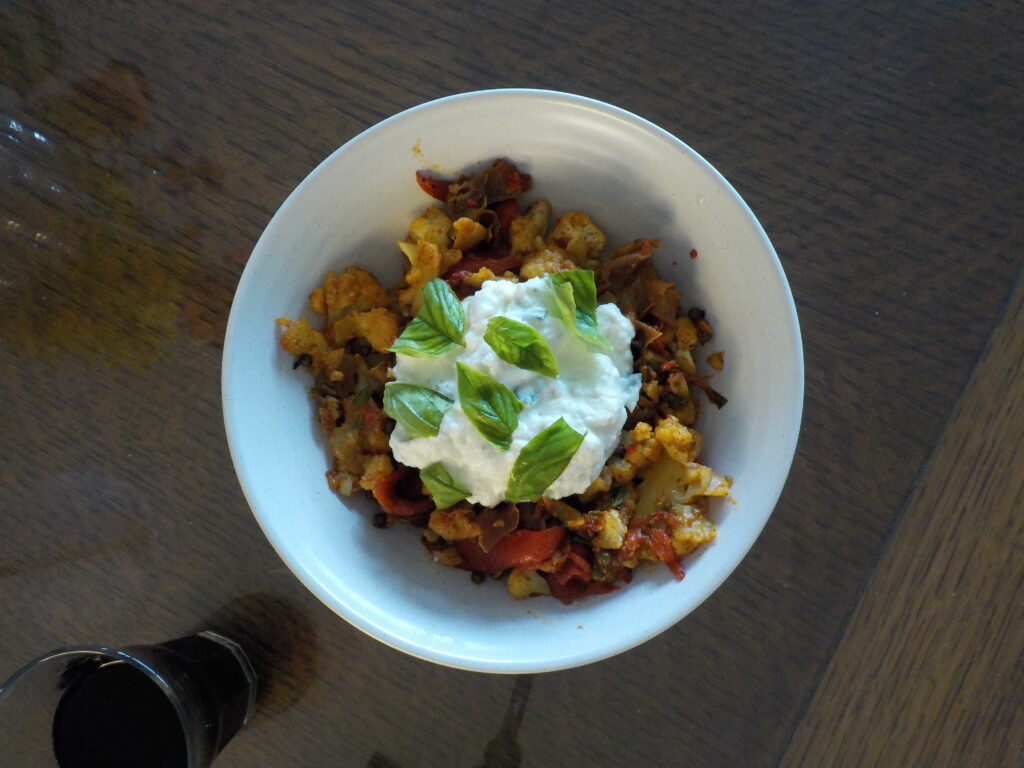
- Put cauliflower mixture in a bowl. Top with heaping spoonfuls of ricotta mixture. Garnish with fresh basil leaves.
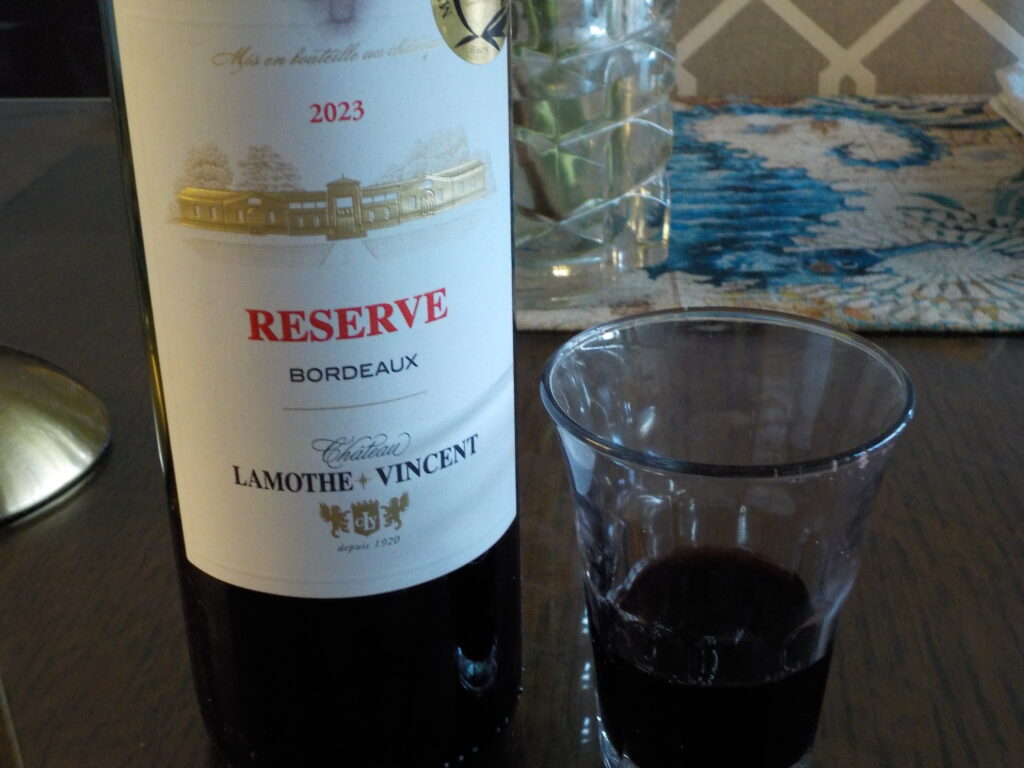
- The Lamothe Vincent 2023 Reserve Bordeaux paired very well with this dish. However a great alternative would be some lime flavored mineral water.
Cook
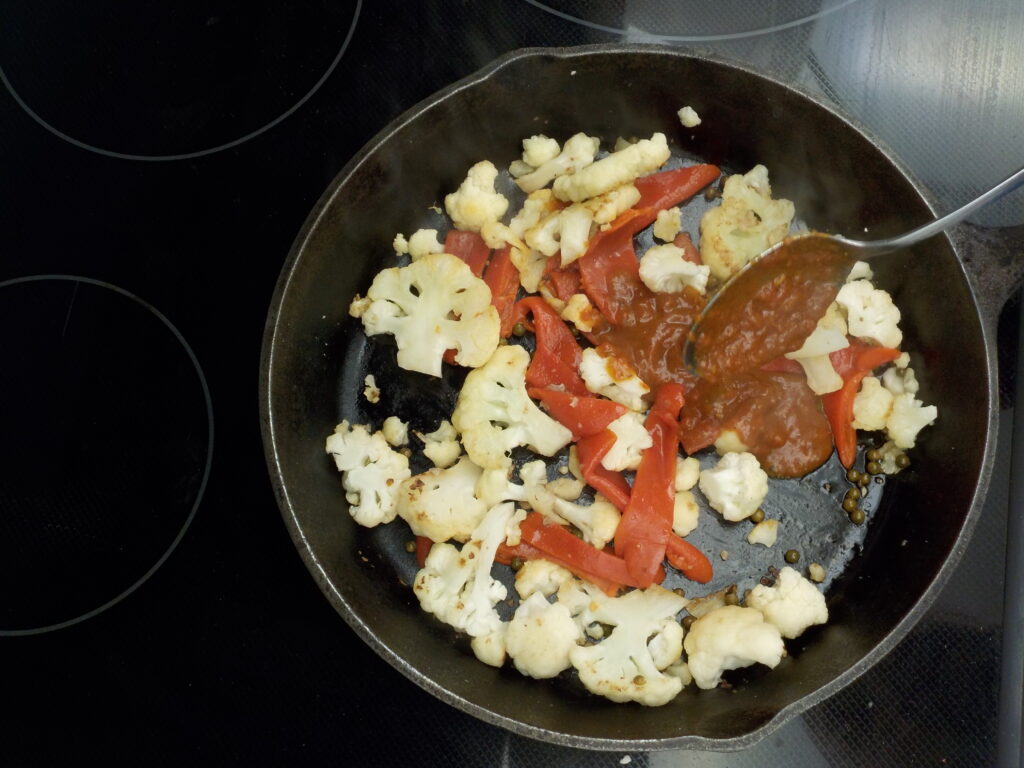
- In a medium heat cast iron skillet, 2 TBS olive oil, cook cauliflower, add green peppercorns and roasted red peppers.
- Add red sauce. I happened to have some leftover red curry sauce, but use whatever red tomato based sauce you would like.
- Salt/pepper to taste.
- Add 1 tablespoon each of basil and oregano.
- After a few minutes, add garlic and red chili peppers and Serrano ham.
- Cook until cauliflower is just the other side of al dente.